
Manhattan's $1.25M Median: Fed Meeting Insights
Real Estate, Manhattan Market, Federal Reserve
Manhattan’s Record $1.25M Median Is a Scarcity Story — What to Do Before the Fed’s July Meeting
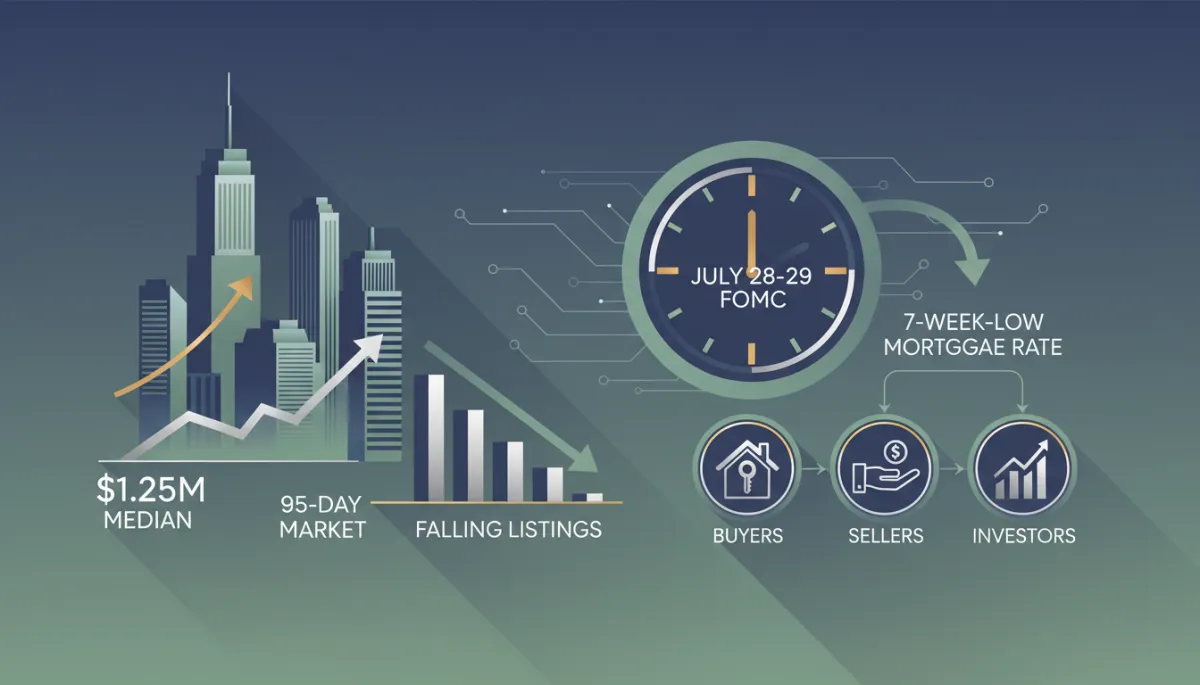
Manhattan just notched a record $1.25 million median sales price in Q2 2026, even as deals slowed and inventory thinned. With mortgage rates hovering near a seven‑week low ahead of the July 28–29 FOMC meeting, buyers, sellers, and investors are staring at a narrow window where scarcity and financing costs collide. Here’s what the latest data really says—and how each group should move now, not later.

Q2 2026 by the Numbers: Why $1.25M Is a Scarcity Signal, Not a Bubble
According to Jonathan Miller of Miller Samuel, the median sales price for Manhattan co‑ops and condos hit $1.25 million in Q2 2026, a 4.2% year‑over‑year increase and the sixth straight quarter of annual gains. That headline number matters, but the context matters more: prices are rising while both inventory and closed sales are falling.
Listings fell roughly 15% year‑over‑year, and total transactions declined by about 6.3% over the same period. In other words, fewer homes are available and fewer are trading—but the ones that do sell are doing so at higher prices. That’s the textbook definition of a supply‑constrained market, not a demand collapse. Corcoran’s Q2 2026 update, which pegs median at $1.3 million with signed contracts up 5%, reinforces the same story: buyers are still there, they’re just chasing thinner inventory.
The 95‑Day Market: Slower Pace, Still Competitive
One of the most misunderstood metrics right now is time on market. While Corcoran reports average marketing time around 115 days, many mid‑market Manhattan deals are effectively clearing in about 95 days from listing to contract—a meaningful slowdown from the frenzy of the pandemic era, but still brisk by historical standards for a high‑priced, co‑op‑heavy market like Manhattan.
A 95‑day market tells us two things:
Buyers have a bit more breathing room for due diligence, board packages, and financing, compared with the hyper‑competitive 2021–2022 period.
Well‑priced listings still move—properties that linger are usually mispriced, compromised, or saddled with high carrying costs.

Days on market have eased, but well‑priced, low‑fee homes still draw swift offers.
Mortgage Rates at a Seven‑Week Low: Why Timing Around the Fed Matters
Nationally, 30‑year fixed mortgage rates are hovering around 6.4%–6.5%, based on early July readings from Freddie Mac, Forbes, and other trackers. That’s roughly a seven‑week low after flirting with the upper‑6% range earlier this spring. Fifteen‑year loans are sitting in the mid‑5% range, around 5.7%–5.8%.
For Manhattan buyers, where monthly common charges and taxes already average about $4,466 (roughly $3.37 per square foot), even a modest rate move matters. A 0.25 percentage‑point swing in mortgage rates can shift monthly payments on a $1 million loan by roughly $150–$175—on top of already rising carrying costs. With the July 28–29 FOMC meeting approaching, markets are on edge about whether the Fed will signal more patience or a quicker path to cuts. Either way, volatility around that meeting could nudge mortgage quotes up or down in a hurry.
📌 Key Takeaway: Today’s rates aren’t cheap by pre‑2022 standards, but they’re cheaper than they’ve been in weeks—and they’re interacting with the tightest Manhattan Q2 inventory in nearly a decade.
What Buyers Should Do Before the July FOMC Meeting
In a 95‑day, low‑inventory market, buyers can’t count on “waiting it out” for bargains. But they can stack the odds in their favor before the Fed meets:
Get fully underwritten, not just pre‑qualified. Ask your lender for a full credit, income, and asset underwrite so you can move quickly on a good listing and potentially close within that 95‑day window.
Rate‑shop aggressively this week. With national averages around 6.4%–6.5%, some lenders are still quoting closer to 6.3% on strong files. Locking before the FOMC reduces the risk that a hawkish tone bumps your rate higher.
Prioritize lower carrying costs over “shiny” amenities. With average fees already north of $4,400 per month, a building with strong reserves and modest monthlies may be a better long‑term play than a flashier property with steep charges.
What Sellers Should Do in a 95‑Day, Scarcity‑Driven Market
Sellers may see “record $1.25M median” and assume they can name any price. The data says otherwise: closed sales are down, and buyers are selective. To capitalize before the Fed meeting:
Price into the market, not above it. With listings down 15%, a well‑priced apartment can still attract multiple offers—especially if it’s turnkey and in a low‑fee building. Overpricing is what pushes you beyond that 95‑day mark and invites discount‑hunters.
List before late July if possible. Launching in the weeks leading up to the FOMC meeting lets you market into a window of relatively stable rates. If the Fed spooks markets, higher mortgage quotes could thin out your buyer pool.
Highlight cost predictability. Provide clear documentation on building financials, assessments, and reserves. In a world of rising fees, transparency about stability is a selling point.
What Investors Should Do: Lean Into Scarcity, Underwrite Conservatively
For investors, the combination of record median prices, falling listings, and fewer new development launches (down 37% year‑over‑year per Corcoran) points to one theme: future supply will be constrained. That’s supportive of rents and resale values—but only if you buy with discipline.
Stress‑test your deals at higher rates. Today’s seven‑week‑low mortgage rate is a gift, but underwrite your cash flow as if rates were 0.5 percentage points higher and common charges 10% higher. If the deal still works, you have a margin of safety.
Focus on durable rental demand. Neighborhoods with strong job access, transit, and institutional anchors (hospitals, universities, major employers) are better positioned if the economy wobbles after future Fed decisions.
Move quickly on mispriced listings. In a 95‑day market, outliers—estate sales, tired listings with quiet price cuts—can still be found. Have financing lined up before the July meeting so you can execute before any rate volatility hits your pro forma.
The Bottom Line: Use This Window, Don’t Wait for a Perfect One
Manhattan’s record $1.25 million median isn’t a frothy blow‑off top; it’s the logical outcome of years of underbuilding, fewer new launches, and owners reluctant to give up low‑rate mortgages. Pair that with a seven‑week‑low in current mortgage rates and a roughly 95‑day selling timeline, and you get a market where thoughtful, prepared participants can still win—if they act before the Fed potentially reshuffles the deck on July 28–29.
Whether you’re buying, selling, or investing, the strategy now is the same: respect the data, secure your financing, and move deliberately within this scarcity‑driven window—before the next Fed statement turns today’s “good enough” conditions into yesterday’s missed opportunity.